
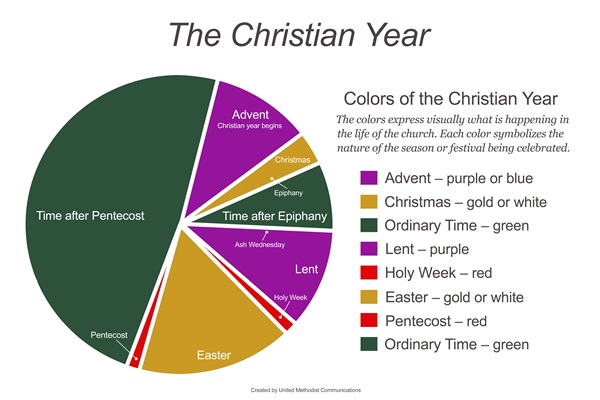
United Methodists—along with Catholics and many Protestant traditions—organize the year into different seasons that reflect the life of Jesus Christ and foundational moments in the early Church. This is known as the Christian year or liturgical calendar.
The Christian year includes six seasons and four key holy days: Christmas Day, Epiphany, Easter and Pentecost. Christmas Day and Epiphany always fall on the same date each year—Dec. 25 and Jan. 6, respectively—while Easter and Pentecost are always celebrated on Sundays, their dates determined by the lunar calendar.
Each holy day marks a transition between seasons, and each season is associated with a liturgical color that symbolizes the spirit of the time. These colors adorn sanctuaries and worship spaces as visible reminders of the Church’s journey through the Christian year.
Here is a brief look at each of the seasons and the holy days that accompany them, beginning with Advent.
Advent (season)
Advent begins the Christian year, even as it coincides with the end of the secular calendar. From the Latin word adventus, meaning “coming,” Advent is a time of preparation to celebrate the arrival of Christ into the world, not just Christ's first coming in the Nativity Story, but also his Second Coming.
Advent starts on the fourth Sunday before Christmas, typically just after Thanksgiving. Each Sunday, a new candle is lit on the Advent wreath. On Christmas Eve, a central white candle—known as the Christ Candle—is lit to mark Christ’s birth.
The colors of Advent are purple and, in some churches, blue. Purple signifies both penitence and royalty, reflecting both the solemnity of the season and the coming of the King. Blue is often used to express hope and anticipation. While Advent is celebratory, it is also a time for prayerful reflection and spiritual readiness.
Christmas Day (holy day)
Advent ends on Christmas Day, Dec. 25, a time when the Christians gather to celebrate and contemplate the incarnation of God in Jesus Christ beginning on Christmas. In keeping with ancient Hebrew tradition, many churches mark Christmas beginning at sunset on Dec. 24. Most United Methodist churches hold Christmas Eve services rather than separate services on Christmas Day—unless the Christmas Day falls on a Sunday.
Christmas marks the beginning of the season of Christmastide. For many, the day is spent at home with family, exchanging gifts and sharing festive meals.
Christmas (season)
The Season of Christmas (sometimes referred to as Christmastide) begins on Dec. 25 and ends on Epiphany (January 6). The liturgical colors of Christmastide are gold and white, symbolizing Christ’s royalty and purity.
New Year’s Eve falls within this season, and some United Methodist congregations hold Watch Night services to rededicate themselves to God. On Jan. 1, many observe the Feast of the Holy Name of Jesus, recalling the day Jesus received his name, in accordance with Jewish tradition eight days after his birth (Luke 2:21).
In some cultures, the end of Christmas is marked with a festive “Twelfth Night” dinner or the baking of a King Cake, inside which a bean or trinket is hidden to symbolize Christ. The person who finds it may be crowned and asked to host the next year’s celebration. House blessings are another common tradition near this time.
Epiphany (holy day)
Epiphany falls on January 6, concludes Christmas and begins the first period of Ordinary Time. Churches typically celebrate Epiphany on the first Sunday after January 1. From the Greek word meaning “manifestation,” Epiphany commemorates the revelation of Jesus to the world. Today, the holiday is most associated with the arrival of the Magi (Matthew 2:1–12), though it historically also celebrated Jesus’ baptism and first miracle at the Wedding at Cana. All of these events are grouped together because they mark different occasions in which other people see who Jesus is or see his power and divinity “manifested”.
Ordinary Time or the Season after Epiphany (season)
Ordinary Time refers to two periods in the Christian calendar: the time between Epiphany and Lent, and the time from Pentecost to Advent.
The Season after Epiphany typically runs from mid-January to mid-February or early March. The liturgical color is green, symbolizing growth, vitality and spiritual development. While called “ordinary,” this season includes meaningful observances such as Baptism of the Lord Sunday (the week after Epiphany) and Transfiguration Sunday (the final Sunday before Lent). For more information on ordinary time watch this free video.
Lent (season)
Lent begins with Ash Wednesday and spans 40 days (excluding Sundays) leading to Easter. It is a season reserved for intensive preparation of candidates for baptism as well as spiritual growth for those already baptized. It's also a season of repentance, self-examination and spiritual preparation for all Christians. The word “Lent” comes from an Old English term meaning “spring,” a time of planting and preparation. Christians observe Lent through prayer, fasting, acts of service and worship. The color for Lent is purple, though churches use red during Holy Week to symbolize Christ’s sacrifice.
The season begins with Ash Wednesday services in which ashes are imposed on the forehead in the shape of a cross. The ashes, a sign of mortality and penitence, remind Christians of their need for God’s grace. The final week of Lent is known as Holy Week and includes Palm Sunday, Maundy Thursday, Good Friday and Holy Saturday commemorating Jesus’ passion and death.
Easter Sunday (holy day)
Easter is the most significant day in the Christian year, celebrating Christ’s resurrection from the dead. It is observed on the first Sunday after the first full moon following the vernal equinox, which also determines the dates for both Lent and Pentecost.
As with Christmas, Easter begins after sunset on Holy Saturday. The first service of Easter, the Great Vigil, is the most ancient Christian celebration. It includes services of light, word, water, and table. It may be held either as an evening service on Saturday or as an early morning service on Sunday (the original “sunrise service”).
Easter symbolizes new life and victory over death. United Methodists typically celebrate the Lord’s Supper, sing hymns such as Charles Wesley’s “Christ the Lord Is Risen Today,” and decorate sanctuaries with Easter lilies. The color of white is most associated with Easter.
Easter (season)
The Season of Easter (or Eastertide) begins on Easter Sunday and continues for 50 days, ending on Pentecost. The season’s colors are white and gold, celebrating resurrection, royalty and glory. This is a joyful time in the church year, contrasting the spirit of somberness often associated with Lent.
From the time of the early Church, Easter Season was used for “mystagogy,” leading the newly baptized to understand the mystery of what had happened to them in baptism and helping them understand and commit to use the gifts of the Holy Spirit they have received.
Easter Season a great time for spiritual formation. Many churches offer theological or discipleship classes, and Confirmation Sunday — where youth profess their faith publicly and become church members — often takes place during this season. This season also includes Ascension Day, marking Jesus’ return to heaven 40 days after his resurrection.
Pentecost (holy day)
Pentecost, from the Greek for “fiftieth,” falls on the eighth Sunday after Easter. It celebrates the descent of the Holy Spirit upon the apostles, enabling them to speak in various languages (Acts 2). Pentecost is often seen as the birth of the Church.
Pentecost is a day of commitment. It may be the day of confirmations, as well as a day when those who have been discerning their spiritual gifts and be commissioned to use those gifts in the name of Jesus and the power of the Holy Spirit.
The liturgical color is red, representing the Spirit’s fire. Both clergy and laity are encouraged to wear red during worship. While Easter is associated with spring, Pentecost is connected to summer. Pentecost is a time to reaffirm the Church’s mission to “make disciples of all nations” (Matthew 28:19–20) and to celebrate unity in diversity. Many churches sing songs or offer prayers in different languages.
Ordinary Time or Season after Pentecost (season)
The final and longest season of the Christian year stretches from Pentecost to Advent, covering most of the summer and fall. Its color is green, again symbolizing growth and life.
Those who were confirmed or commissioned to use their spiritual gifts are setting out as professing members and beginning a season of new ministries.
Despite the name, this season is rich with church activity. Special observances include Trinity Sunday (first Sunday after Pentecost), All Saints Day (November 1) and Christ the King Sunday (last Sunday before Advent). Churches often host Vacation Bible School, youth mission trips and summer camps during this time.
Conclusion
The liturgical calendar provides a fulcrum for churches and pastors, guiding them in worship, preaching and discipleship throughout the year. By following the liturgical calendar, Christians live into God’s time — kairos — rather than being bound solely to the rhythms, demands and distractions of the world. It connects their own lives to that of Christ and the early church inviting them to a deeper relationship with God. More than this, observing these seasons provides a plan for congregations to focus on calling, preparing, baptizing, teaching and sending disciples of Jesus for the transformation of the world.
This content was produced by ResourceUMC on May 9, 2025. Philip J. Brooks is a writer and content developer at United Methodist Communications. Contact him by email.